
Claiborne VINELink Release Coverage
Louisiana calls its service the Louisiana Automated Victim Notification System, or LAVNS, and uses the national VINE/VINELink platform. The Louisiana VINELink route supports offender or custody searches and custody-change notifications. DPS&C directs its public inmate information to LAVNS and says prison, probation, and parole data updates every 24 hours.
The Claiborne Parish Sheriff links a roster on the LAVNS domain. Indexed roster text also invites anonymous registration for changes in an offender’s custody status. Those facts strongly support a local VINE layer. Still, no official statewide page located in the research listed every participating parish facility or promised complete historic retention. Verify the reporting agency on a live result, or call VINE help at 866-277-7477, Option 2, when coverage is uncertain.
VINE is a notification channel, not the agency’s final release ledger. It can report a custody event from a participating jail or state system. It does not replace CPSO’s custody movement record, DPS&C’s release record, or the court order that supplied legal authority.
Search Claiborne VINELink Inmates
Search one person at a time. Begin with the last known legal custody, since Claiborne includes local detainees, people held for other parishes, state-sentenced people in parish beds, transitional-program participants, and state prisoners at David Wade. The facility where someone slept does not always identify the agency that controls the release record.
- Open Louisiana in VINELink and select the offender or custody search offered in the live interface.
- Enter the person’s full legal name. Repeat with an offender, booking, or case identifier when the interface offers that field.
- Use date of birth or age, facility, and reporting agency to distinguish people with similar names. Do not rely on a photo comparison alone.
- Open the matching record and read the current status, reporting agency, location, event wording, and any displayed event date.
- Save the retrieval time and identifiers. Recheck recent events because the reporting agency and notification system may update at different times.
A no-match is inconclusive. Spelling, aliases, a different legal authority, public-display limits, participation, and update timing can all affect results. For a broader custody-classification path, use the Claiborne Parish released inmate search and move to the office that owns the underlying record.
Read Claiborne VINELink Release Results
A result must be read as a set. A matching name without the right agency or identifier may belong to someone else. A released or out-of-custody status means the named reporting participant transmitted that status. It does not establish why the person left or whether another agency immediately received the person.
Read location words with care. A jail or prison location describes secure custody. A probation or parole record describes community supervision and answers a different question. If the person moves from a Claiborne jail listing to a DPS&C facility, the combined evidence points to transfer. If the state result changes to community supervision, physical release is more plausible, but the facility movement date should still be confirmed.
| Result element | How to use it | Limit |
|---|---|---|
| Name and identifier | Confirm the intended person | A name alone can produce a false match |
| Reporting agency | Identify who transmitted the status | It may not own every related case |
| Custody status | Read the participant’s current reported state | Out of one custody can mean transfer |
| Facility or location | Distinguish local, state, and supervision records | A supervision listing is not jail custody |
| Event date or time | Place the transmitted event on a timeline | It may differ from the alert receipt time |
| Notification option | Register for offered status changes | Delivery is not guaranteed |
The official Louisiana search screen is shown in the captured state interface.
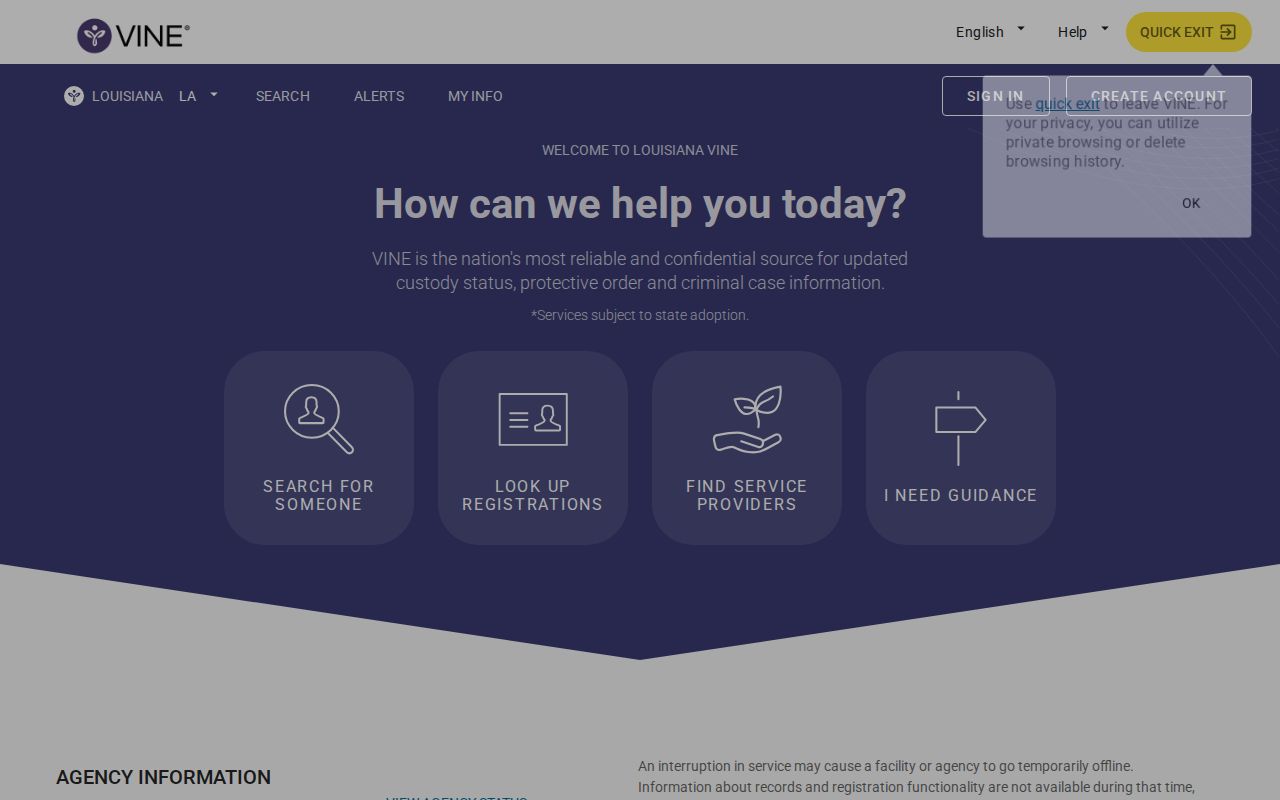
The screen helps locate the search and notification route, while the matching record’s live wording controls how an actual event should be described.
Note: Preserve the event text exactly when it does not specify bond, discharge, transfer, or another precise reason for leaving custody.
Register Claiborne Release Notifications
Registration should follow a verified match. Attaching an alert to the wrong person can create a misleading timeline. Open the correct record, compare identifiers and agency, then select “Get Notified” or the registration wording shown in the current interface. Choose only the events and contact methods the live system offers.
- Select the desired release or custody-change notification on the matching record.
- Choose phone, text, or email if that channel is currently offered.
- Enter current contact information and complete the live security or confirmation prompt.
- If the phone flow requests a PIN, follow its stated prompt. No current authoritative source in the research specified a PIN length.
- Save the confirmation and update contact details when they change. Perform a direct status check when timing matters.
VINE’s guidebook tells registrants to enroll personally and keep contact information current. The system can notify of a reported change, but failure to receive an alert is not proof that no release occurred. Delivery can fail, an event may not match the selected category, reporting can lag, or the registration may point to the wrong record.
Registration is most useful before an expected event, but an expected date is not an actual release. A projected DPS&C date can change, a parole decision can require more processing, and a court order may precede the jail’s execution. Continue to read the person’s live status and obtain the movement record when the physical departure time matters. The alert is one dated piece of evidence, not the complete custody history.
Claiborne LAVNS Roster Notifications
Claiborne has an unusually direct local notification layer: the parish roster itself is hosted on the LAVNS domain and its indexed text offers anonymous custody-status registration. That local path is more relevant than an app from another sheriff’s office. No official Claiborne sheriff mobile app was identified, so the web roster and VINELink are the documented digital routes.
The roster is still a current population list. Its indexed fields are Name, DOB, Race, Gender, and Arrest Date, with an offender count and Central Time update stamp. No list-level release date or reason appeared. A roster status notice may signal that a record changed, but the facility record remains necessary to identify physical release, transfer, or another disposition.
Save four items when a notice arrives: exact event wording, reporting agency, event date or time if displayed, and receipt time. Compare those details with the last roster observation. If the notification says only “release,” ask the owning office whether it meant bond, court order, time served, sentence completion, transfer, or another recorded outcome.
Claiborne VINELink Release Limits
VINELink does not cover every custody system in the same way. The BOP locator is the correct public route for a sentenced federal prisoner. ICE has its own detainee locator. A federal pretrial matter may require the federal docket, U.S. Marshals information, and the actual contract jail. A Louisiana VINE no-match should not be used to infer release from any of those systems.
State results also require care. DPS&C says its LAVNS information includes people in prison and those under probation or parole. A community-supervision result supports that the person is outside secure imprisonment, but it does not mean the sentence has fully expired. A parish roster disappearance followed by a new state facility can indicate transfer. A state supervision entry can indicate physical release with continuing parole or probation.
Louisiana’s State Police registry is another narrow system for people legally required to register. It is not a general released-inmate search and does not prove when someone left Claiborne custody. Keep each source within the question it was designed to answer.
Confirm Claiborne VINELink Releases
Confirmation follows the custody type. For a Claiborne local booking, obtain CPSO’s custody movement or release record and check Second Judicial District minutes for the legal basis. CPSO requires certified-mail public-record requests to its liaison at 300 Highway 146, Homer. Ask for the recorded date and time, release type, destination, and receiving agency.
For a state sentence, use the reporting agency and DPS&C identifier. The telephone locator at 225-383-4580 accepts a DPS&C number or name plus date of birth and can provide a projected release date if applicable, but a projected date is not proof that release happened. For parole, pair the Committee action with the facility movement and current supervision status. For a full discharge that is no longer public online, seek the DPS&C release or discharge record.
| VINELink observation | Next confirmation |
|---|---|
| Out of custody from a Claiborne jail | CPSO movement record and court minutes |
| New DPS&C facility | State status and transfer records |
| Probation or parole status | Assigned supervision office and relevant decision |
| No result | Repeat identifiers, call VINE help, then use the owning agency |
| Federal or immigration case | BOP, ICE, federal court, or actual holding facility |
The Louisiana Crime Victim Services Bureau also has a separate Board notification route at 225-342-1056 or 888-342-6110. VINE enrollment should not be presented as a substitute for every Board notice process. Keep the notification confirmation, the agency record, and any court or parole record together so each stage remains clear.
When two records disagree, preserve both rather than choosing the more convenient result. A court record governs what the judge ordered. The jail record governs the physical exit from that facility. DPS&C governs the state sentence and supervision data. VINE governs only the event delivered through its participating system. Comparing those roles often explains a seeming conflict without turning a delayed update into an unsupported claim.
- Release
- The end of physical custody for a specified event or authority.
- Discharge
- The end of the specified sentence or supervision obligation.
- Parole
- Release from prison while the sentence continues under supervision.
- Transfer
- Movement to another facility or authority rather than return to the community.
Note: Describe the agency, event, and time separately when systems disagree, then ask the office that owns each fact to resolve it.