
CPDC Release Paths
Claiborne Parish Detention Center is a local jail operated by the Claiborne Parish Sheriff. Its population is broader than one parish's local bookings. The sheriff says the open-dormitory facility holds men age 17 and older for Claiborne Parish, surrounding parishes, and Louisiana corrections. That mix controls how a facility exit must be read. A local detainee may leave on bond, recognizance, dismissal, a court order, time served, or sentence completion. Another person may be returned to the parish that supplied the bed. A state-sentenced person may move to a Louisiana Department of Public Safety and Corrections placement.
A CPDC release record should state what kind of movement occurred and, when maintained, the destination or receiving agency. That last field matters. "Released from CPDC" describes an exit from one building. It does not, by itself, say that all legal custody ended. A transfer closes the detention center's physical custody while another authority takes over. A bond release can return someone to the community while the court case remains open. These outcomes call for different follow-up records.
| Recorded event | Best next confirmation |
|---|---|
| Bond or recognizance | CPSO movement record and Second JDC bond or minute entry |
| Time served or local sentence completion | CPSO release entry and court sentence or minutes |
| Transfer to another parish | CPSO destination field and receiving parish record |
| Transfer into state custody | CPSO movement entry plus DPS&C or LAVNS status |
Confirm CPDC Release Status
Begin with the last known legal authority. The official sheriff View Inmates route leads to a Claiborne LAVNS current roster. A matching entry supports current reported custody as of the displayed update. An absent entry proves only that the name was not found in that current view. Search spelling variants, aliases, and suffixes before moving on. The indexed list displays name, date of birth, race, gender, arrest date, a changing count, and a Central Time update stamp. It does not show a release date or release reason at list level.
Use this order to confirm a CPDC release or movement:
- Match the full name and date of birth against the current Claiborne roster.
- Check LAVNS or VINE for a custody-status event reported by the participating agency.
- Review Second Judicial District Court minutes for bond, dismissal, sentencing, or a release order.
- Ask CPSO for the existing booking and custody movement or release record.
- If the record names DPS&C or another parish, verify the receiving system with the same identifier.
For a wider person-specific workflow, the Claiborne Parish released-inmate search explains how local, state, court, and federal records fit together. The facility owns the physical movement fact. The court owns its order. DPS&C owns state sentence status. Keeping those roles separate avoids a false conclusion when updates arrive at different times.
CPDC Release Record Fields
A targeted request should identify the person and the confinement event clearly. CPSO does not publish a special release-record form. Ask for existing records as maintained rather than asking staff to prepare a new report. Useful identifiers include full name, aliases, date of birth, an approximate booking or arrest range, the CPDC facility name, and a booking number if known. These details reduce the risk of mixing people with similar names.
The requested material can include the booking sheet and custody movement or release record. State the fields needed, while recognizing that agency labels may differ:
| Requested field | Why it matters |
|---|---|
| Booking number and identity | Ties the exit to the right custody episode |
| Release date and time | Records when physical custody changed |
| Release type or disposition | Separates bond, time served, court order, and transfer |
| Destination or receiving agency | Shows whether another authority took custody |
| Holding agency | Identifies which parish or state system supplied the bed |
A court judgment or minute entry can strongly support the legal reason for release, but it may not record the moment staff carried out the order. Pair the judicial record with the CPDC movement entry. For a state-sentenced resident, add the DPS&C record. Each source answers a different part of the same event.
Request CPDC Release Records
The CPSO public-record procedure says requests are accepted by certified mail only. Address the request to Marla Rowe, Civil Deputy and records liaison, at 300 Highway 146, Homer, LA 71040. The published page lists an email for the liaison, but that does not replace the stated certified-mail submission rule. Keep the mailing receipt and a copy of the request.
Ask for an electronic, non-alterable copy if one is available. Seek a cost estimate before chargeable work begins. CPSO says inspection for adults is arranged at a liaison-designated time and place, Monday through Friday from 8:30 a.m. to 4:30 p.m., except legal holidays. Exact-document copies generally cost $1 each. Pages that need counsel-assisted redaction cost $3 each. Very large requests may involve overtime after written notice and an estimate. The separate $15 report form covers listed accident, incident, and address reports, not a routine CPDC release record.
Louisiana's five-day public-record provision concerns a written determination or reasonable-time estimate after a request. It is not a promise that production will finish within five days. A narrow date range and known booking number can make the search more precise. If CPSO reports no responsive record, confirm which parish or state agency supplied the person before concluding that no movement record exists.
CPDC Mixed-Custody Release Records
Claiborne Parish has an unusual cluster of custody programs. The men's detention center, a separately listed women's jail, a co-located transitional work program, and a state prison all operate within the parish. CPDC itself may house people for nearby parishes or DPS&C. The same name may therefore appear in local and state channels for one confinement period. That is not necessarily a duplicate booking.
Compare identifiers and the reporting facility. If the sheriff record says transfer to DPS&C and the state entry soon names a new institution, those records align. If a court grants bond but a sheriff entry shows transfer on a separate hold, the person did not necessarily return to the community. A detainer is a request by another authority to take custody when the first custody ends. The receiving-agency entry can explain what happened where a simple roster check cannot.
The official CPSO facility description shows the detention center's mixed role.
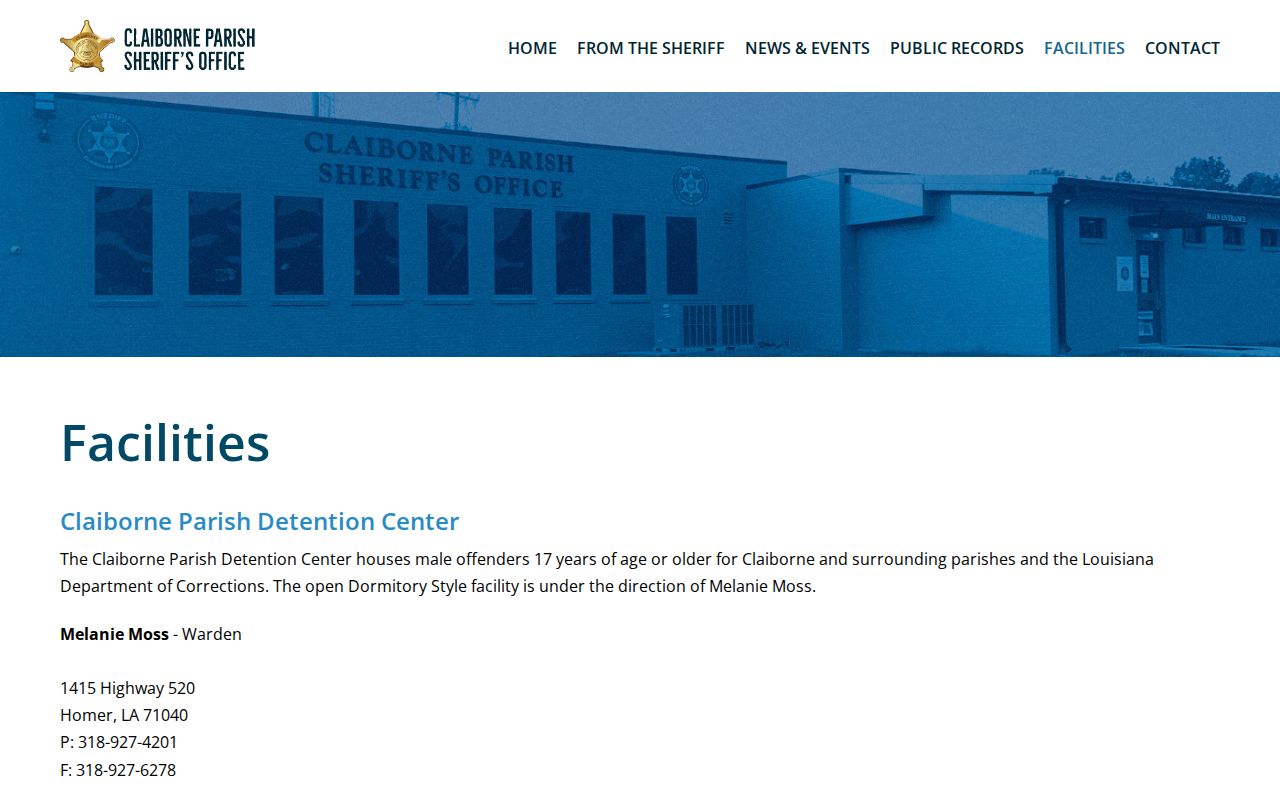
The source helps explain why CPDC departure and full release are not interchangeable facts. Always trace the authority that supplied the bed.
CPDC State-Sentence Movements
A state-sentenced person can remain under DPS&C legal custody while housed at CPDC. For that person, the local record documents movement from the detention center. It may not establish release from the state sentence. Search Louisiana LAVNS by full legal name, then by DPS&C number or case ID. Read the status and reporting agency carefully. A new state facility supports transfer. A community-supervision entry may support physical release, but the event date and authority still need confirmation.
The DPS&C telephone locator at 225-383-4580 accepts a DPS&C number or a name with date of birth. It can provide a current placement, facility contact details, and a projected release date if applicable. A projected date looks forward and may change. It does not prove that CPDC released the person on that day. For parole, check the Committee on Parole action and then confirm the assigned supervision office. For a full discharge no longer displayed online, seek the state release or discharge record.
David Wade Correctional Center adds a regional layer. Its records operation supports state classification and sentence work across many parish facilities and transitional programs. Thus, a person may be physically in Claiborne local custody while decisive time computation remains a state record. This regional structure is why the CPDC destination field is so valuable.
CPDC Release Contact
Call the detention center to confirm which physical facility and records custodian apply before sending a request. Phone guidance can help route the inquiry, but the durable proof is the custody or release record. No official Claiborne source gives a guaranteed release hour, public exit gate, property-return procedure, weekend schedule, transportation plan, or family waiting area. Staff may give current logistical directions, yet those details should not be assumed in advance.
Have the person's full name, date of birth, approximate booking date, and known booking or DPS&C number ready. Ask whether the person was held for Claiborne Parish, another parish, or the state. Then direct the written record request to the authority that owns the fact being checked.
Note: Call before travel because no official source publishes CPDC release times, pickup locations, or waiting procedures.
Read CPDC Release Outcomes
Use precise terms when reporting the result. Bond ends physical detention for that booking while the case continues. Time served means confinement credit satisfies the ordered jail term. A transfer moves the person to another authority and is not community release. Parole ends prison confinement while the sentence continues under supervision. A discharge ends the relevant correctional term, though another case or hold may still exist.
- Release record
- The facility record of when custody changed and the disposition staff recorded.
- Receiving agency
- The parish, state, or other authority that accepted custody after CPDC.
- Detainer
- A request for another authority to take custody when the current confinement ends.
- Disposition
- The recorded outcome, such as bond, time served, court order, or transfer.
A clean confirmation states the source and date. For example, the sheriff record may show a CPDC exit on one date while the court minute supplies the bond authority. If a state placement follows, name it as a transfer. Avoid converting a lack of search results into a factual claim. Records can lag, names can differ, and lawful limits may restrict public display.