
Claiborne Projected Versus Actual Release
DPS&C uses the precise phrase “projected release date (if applicable).” It is an administrative estimate based on the sentence information and credits then recorded. It looks forward. An actual release date records that a person physically left the named facility or legal custody. One date cannot substitute for the other.
A pretrial detainee usually has no computed prison release date because the next event depends on bond, dismissal, plea, trial, sentencing, or another court order. A person serving a sentence may have a calculated date, yet that date can move. A parole eligibility date only marks when consideration may begin. A hearing date marks Committee review. A grant is a decision. The facility exit is the executed movement.
| Date | What it means | What it does not prove |
|---|---|---|
| Projected release | Current administrative sentence estimate | That departure occurred |
| Parole eligibility | Possible point of Committee consideration | A grant or release |
| Parole decision | Committee action on the case | Exact facility exit time |
| Actual release | Recorded physical custody movement | Full-term expiration or end of supervision |
Find Claiborne Projected Release Dates
Start with the last known custodian. A sentenced state prisoner, including a DPS&C person held in a parish bed, belongs in the Louisiana corrections search and telephone locator. A local pretrial or parish-sentence question belongs with CPSO and the Second Judicial District court. The label on the record matters because Claiborne Parish Detention Center holds people for the parish, surrounding parishes, and DPS&C.
- Identify the last confirmed facility and whether the case is local, state-sentenced, federal, or immigration related.
- For a DPS&C case, search Louisiana VINELink by full name, then by DPS&C or case ID. Compare date of birth, facility, and reporting agency.
- Call the DPS&C locator at 225-383-4580 with the DPS&C number, or the name and date of birth, and ask for the “projected release date (if applicable).”
- For a local case, read the Second JDC docket for bond, sentence, credit for time served, or later court orders. Ask CPSO which custodian owns the release calculation.
- Record when each result was retrieved. Treat a no-match as inconclusive and move to the records office rather than guessing.
- After the expected day, obtain the custody movement or discharge record to verify what actually occurred.
The official DPS&C inmate-information instructions document the search methods and telephone field.
The source supports name, location, and ID or case-number searches, but it does not promise a permanent released-person archive.
Claiborne Release Date Law Change
Louisiana's computation regime turns on the offense date of August 1, 2024. For an eligible felony offense committed on or after that date, R.S. 15:571.3.1 generally allows up to 15 percent diminution for good behavior in parish-prison or DPS&C custody. Diminution means a reduction credited against custody. The common 85 percent shorthand is valid only when the person qualifies and earns the maximum without losing it.
The statute excludes listed categories, including sex offenses under R.S. 15:541 and habitual-offender sentences under R.S. 15:529.1. It does not award good time under that section for presentence time credited under Code of Criminal Procedure article 880. Credits may also be forfeited under R.S. 15:571.4. These limits make a universal 85 percent claim wrong.
The current statute can be read in its official format.
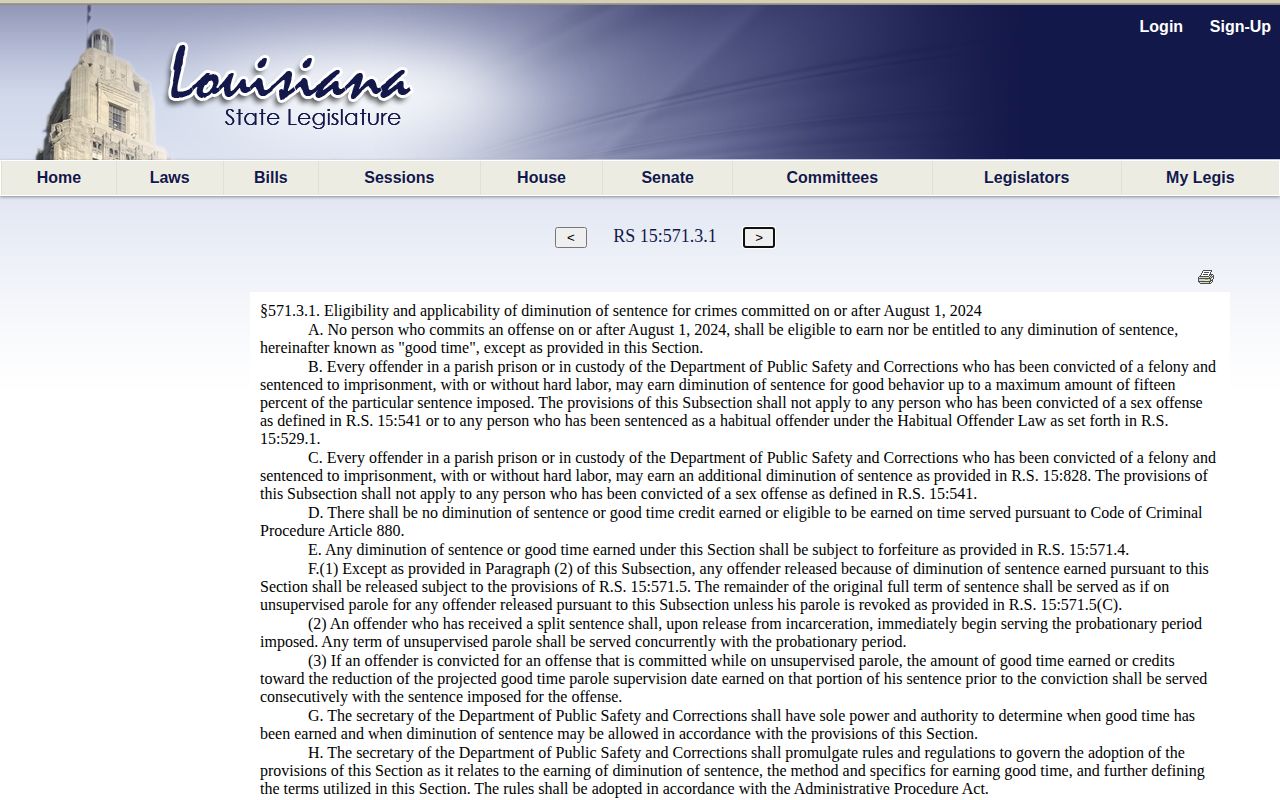
The statute image shows why eligibility and earned credit must be established before a projected date can be discussed.
Most releases under that diminution serve the balance of the original full term on unsupervised parole under R.S. 15:571.5. A split sentence moves into the imposed probation term, subject to statutory rules. Physical departure can therefore occur before full-term expiration.
Older Claiborne Release Date Formulas
Older offense dates remain under R.S. 15:571.3 and its distinct categories. The published text includes a 30-days-for-30-days formula for certain parish sentences without hard labor, 3 days for every 17 for a qualifying first crime of violence, 13 for 7 for qualifying DPS&C felony cases, 1 for 3 for certain qualifying first violent offenses, and 1 for 2 for certain fourth or later nonviolent cases. These ratios cannot be blended or chosen by analogy.
The older law appears in the official statute capture.
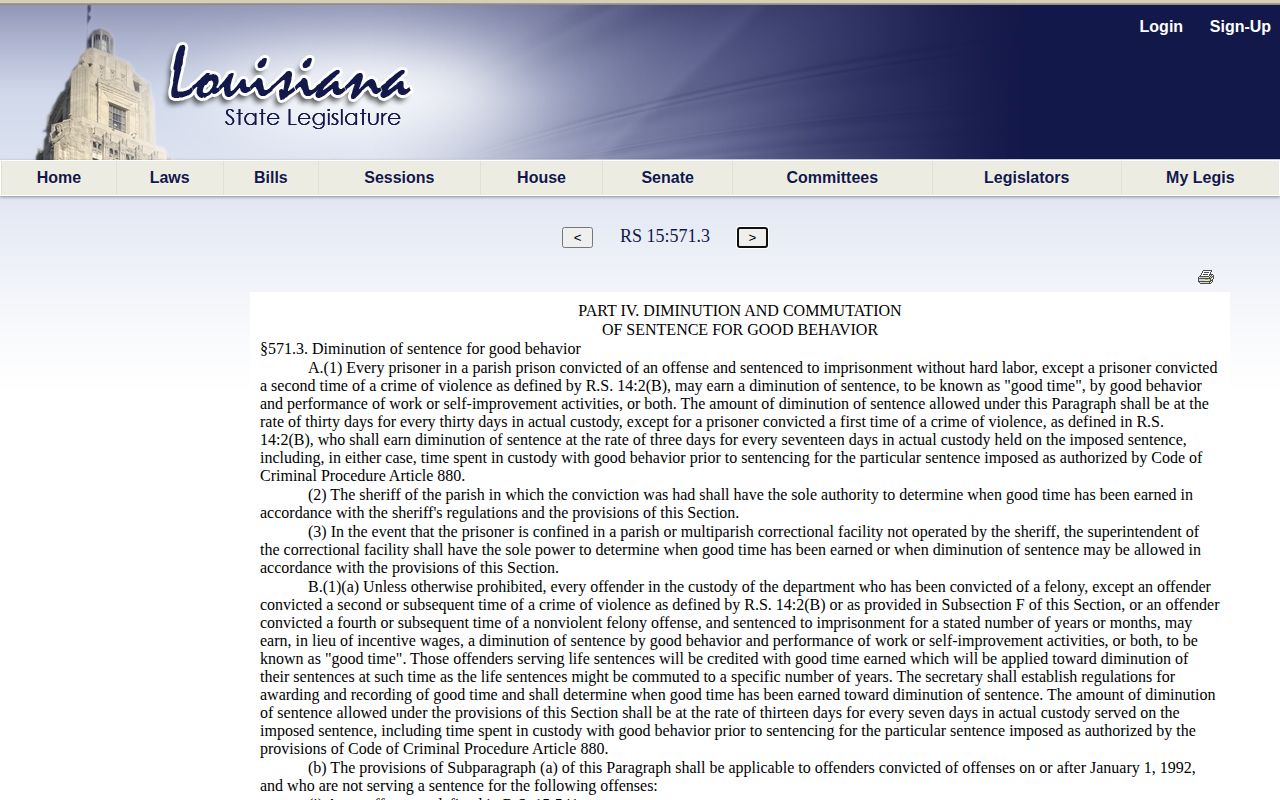
The range of formulas shows why the offense date, classification, prior record, and revocation history must be known first.
R.S. 15:828 may add program credits for eligible people. Its published limits include up to 360 days for certified treatment or rehabilitation programs, up to 180 days for a qualifying workforce-development work-release program, and specified 90-day higher-degree credits. Exclusions and administrative rules apply. The statutory term “projected good time parole supervision date” remains a computation term, not a confirmed exit.
Claiborne Release Date Computation
Do not calculate an individual date from a sentence length alone. First identify the offense date, not merely conviction or sentencing. List every count and determine whether terms run at the same time or one after another. Then account for credit for time served, felony class, crime-of-violence or sex-offense status, habitual-offender status, and any revocation. Only the responsible records office can apply earned and forfeited credits to the complete record.
A limited example explains the arithmetic without predicting a person’s case. If an eligible newer felony sentence is 1,000 days and the full 15 percent ordinary diminution is earned and kept, the statutory maximum reduction in that example is 150 days. The result can change because of exclusions, presentence-credit treatment, program credits, forfeiture, or multiple sentences. It should never be displayed beside a named person as their date.
- Concurrent
- Sentence terms that run at the same time.
- Consecutive
- Sentence terms that run one after another.
- Good time
- Credit that may reduce custody for an eligible person under the controlling law.
- Detainer
- A request or notice from another authority that can affect what happens at release.
Why Claiborne Release Dates Change
A projected date is recomputed when the legal or administrative inputs change. David Wade Correctional Center's official page identifies its Records Office as responsible for computation and recomputation. For a state case housed elsewhere, DPS&C still owns the state calculation. The parish jail owns its physical movement record, not every state sentence input.
| Change | Possible effect | Source to verify |
|---|---|---|
| Credit earned or forfeited | Moves the projected date | DPS&C computation record |
| Corrected sentence data | Changes the term or start point | Court order and records office |
| New conviction or revocation | Adds or restores custody time | Court or revocation decision |
| Program credit | May reduce an eligible calculation | DPS&C program and computation records |
| Other-agency hold | May change destination, not the first custody end | Movement record and receiving agency |
| Parole action | Changes eligibility or authorized path | Committee docket and ruling |
Note: A hold can make one facility report release while another authority immediately accepts custody, so the destination field is essential.
Claiborne Parole and Release Dates
Parole eligibility is separate from good-time computation. R.S. 15:574.22 generally makes people with offenses committed on or after August 1, 2024 ineligible for parole except for categories listed in R.S. 15:574.4. Older and special cases can involve 25, 65, or 75 percent provisions, along with life-sentence, juvenile, elderly, and other routes. Eligibility does not guarantee a hearing result or release.
Keep four labels apart: eligibility date, hearing date, grant date, and facility release date. The Committee on Parole owns the decision. The prison owns the movement. The Division of Probation and Parole owns the community case. If any one source is missing, describe only the stage that the existing record supports.
A person released through good time may be on unsupervised parole until the original full term. Someone with a split sentence may enter probation. Thus physical custody end, community status, and sentence expiration can be three different dates.
Confirm Claiborne Actual Release Dates
After the projected day, recheck the reporting agency and request the movement record. A Louisiana VINE notification can flag a transmitted custody change, but it may not explain whether the event was discharge, bond, transfer, or another disposition. The Claiborne VINELink release check covers one-person searches and alerts.
For a local exit, ask CPSO for the existing booking sheet and custody movement or release record, including date, time, release type, and destination or receiving agency. For DWCC or another state placement, request the DPS&C discharge and computation records. Court minutes can establish authority, yet they may not establish the time staff executed it.
If the result still shows custody after the projected date, do not label it an error without checking update timing and recomputation. If the person disappears, do not label that a release. Preserve the identifier, retrieval time, and source, then obtain the agency record that states what happened.
Claiborne's mixed custody map makes the final comparison especially important. A DPS&C-sentenced person may be physically held at the detention center or transitional work program, while David Wade Correctional Center also serves a broad regional role. A local roster exit can record a movement into another placement. It may occur on a date that has nothing to do with community release or full-term expiration.
Build a short chronology from the records: the last confirmed custody date, the latest projected date, any Committee action, the actual movement timestamp, the receiving agency or community status, and the full-term date if supplied. Do not merge blanks in that sequence. If only a court order exists, it shows authority. If only LAVNS changes, it shows a reported status event. The movement or discharge record is still needed for the executed outcome.
For a record request, identify the full name, date of birth, DPS&C or booking number, facility, approximate sentence and release dates, and court case number when known. Ask for the existing time-computation sheet, release or discharge record, and any public field stating the release type. If material is redacted, request the segregable public portion and the legal basis for each withheld part.
Current web display and agency retention are not equal. R.S. 44:36 generally provides a three-year public-record minimum unless another law or approved schedule applies. DPS&C adult-offender records have a special minimum tied to six years after full-term expiration or death. That rule supports a records-office fallback, not a promise that a former prisoner will remain searchable online.