
Claiborne Released Mugshot Records
A booking photograph documents appearance when an arresting or holding agency processed a person. It belongs to the arrest event, not the later release. A person can leave custody while the maintained photograph remains in an agency file. Public visibility may still change because of lawful redaction, an ongoing investigation, a sealed matter, expungement, or the limits of an online interface.
Louisiana law does not make every government photo automatically available through a public webpage. The sheriff's list-level roster fields observed during research were Name, date of birth, race, gender, and arrest date. No photo column appeared in that indexed view. The live detail page could not be verified reliably, so its photo behavior is unknown rather than absent.
A mugshot is also not a release record. A custody movement record states whether the person left on bond, by court order, after time served, through transfer, or under another disposition. Match a photo to a booking number, date of birth, and facility, then use the movement record for what happened next.
Find Claiborne Released Inmate Mugshots
Use official channels first and keep each channel's scope intact. A sheriff photograph belongs to the local booking. A DPS&C or LAVNS image, if displayed, belongs to that state correctional record. A news image may depict an enforcement event but may not be the maintained booking photograph. Commercial archives and other third-party snapshots can be discovery leads only and receive no endorsement or direct link here.
| Channel | Photo status | How to access |
|---|---|---|
| Claiborne LAVNS roster | No photo field at list level; detail unknown | Open the official sheriff View Inmates route and verify live fields |
| CPSO records request | Ask for the maintained booking photograph | Submit a targeted certified-mail request |
| DPS&C or LAVNS | Not promised for every released person | Check the live state record, then request the state file if needed |
| CPSO news archive | Some selected articles include event material | Search official news by date and name |
| Third-party snapshot | May be old, incomplete, or mismatched | Use only as a lead; confirm with the originating agency |
The official CPSO home page supplies the View Inmates route. A current roster hit shows reported custody as of the update, not a released-person photo archive. If the name has dropped away, switch to the records request rather than comparing screenshots to infer release.
No Claiborne Mugshot Mobile App
No official Claiborne Parish sheriff mobile app was identified in the sheriff navigation or the app sweep. This is a narrow finding, not a claim that no app could ever appear. Do not install an unrelated sheriff app or assume that another parish's product carries CPSO records. The verified local digital routes are the CPSO website, its LAVNS roster link, its public-record procedure, and its news archive.
The missing app matters because some counties place images in an app even when a browser list does not show them. No such Claiborne channel can be promised from the reviewed sources. A person seeking a released inmate photograph should use the web roster only for live discovery, then request the agency's existing image.
There is also no official Claiborne 24-hour or 72-hour release-photo feed. The roster is a current-custody list. Its disappearance behavior cannot distinguish release, transfer, correction, or a system problem. The Released Last 24 Hours page explains that same-day fallback without inventing a feed.
Request Claiborne Booking Photos
CPSO says public-record requests are accepted by certified mail only. The public page lists Marla Rowe, Civil Deputy and records liaison, at 300 Highway 146, Homer, LA 71040. It also lists an email contact, but the explicit submission rule remains certified mail. Keep the mailing proof and a complete copy of the request.
- Identify the person by full name, aliases, date of birth, approximate booking dates, booking number if known, and the facility.
- Ask for the existing booking photograph in the format maintained. Do not ask the office to create a montage or altered image.
- Also request the booking sheet and custody movement or release record when the goal includes confirming what happened after booking.
- Ask for an electronic non-alterable copy if available and request a written estimate before chargeable work begins.
- Mail the request by certified mail to Marla Rowe, Civil Deputy and records liaison, 300 Highway 146, Homer, LA 71040.
- Track delivery, reply, estimate, payment, and production. Preserve any legal basis given for withholding or redaction.
The CPSO public-record procedure shows the local submission and fee rules.
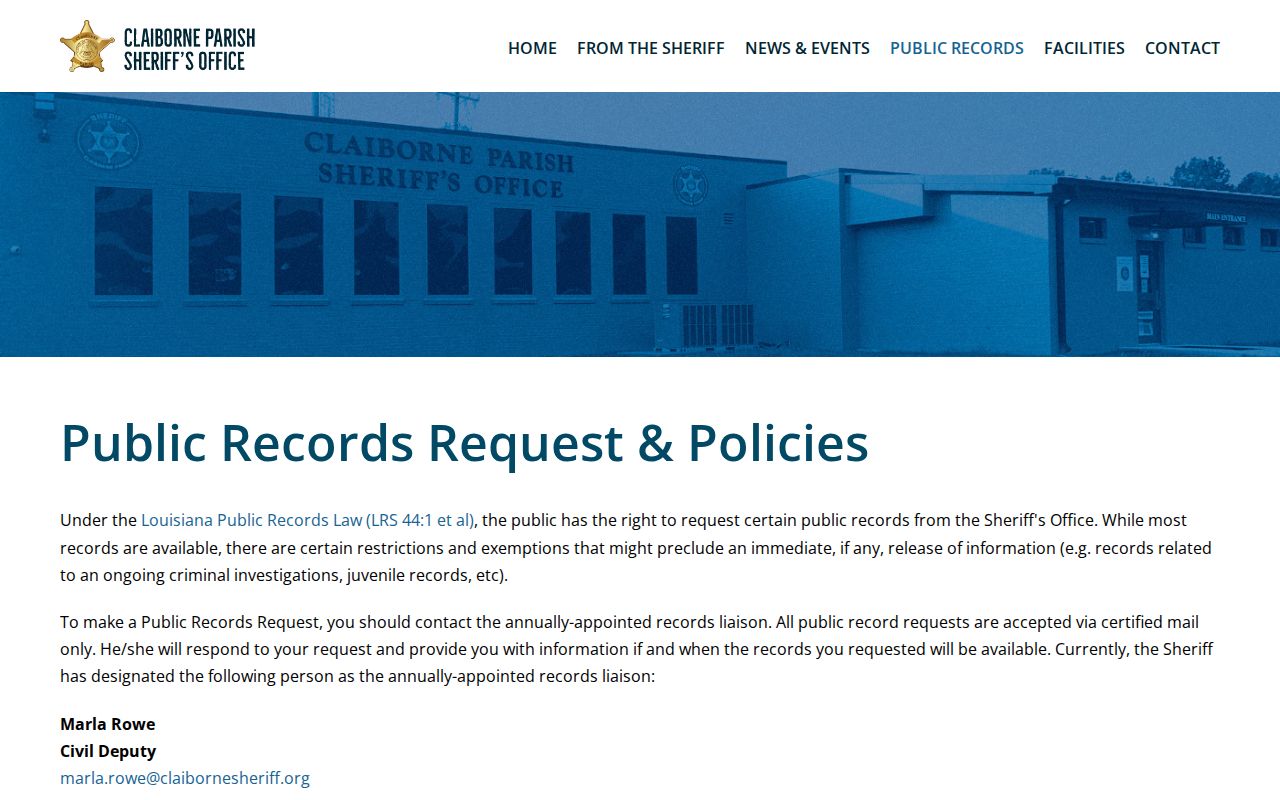
The source supports a request for records as maintained. It does not promise that every photograph is public or that a special online photo file exists.
| Published item | Amount |
|---|---|
| Exact-document copy | Generally $1 each |
| Redacted page requiring legal counsel | $3 each |
| Unusually large request | Possible overtime after written notice and estimate |
| Special booking-photo charge | No separate amount stated |
The sheriff's $15 money-order Report Request Form applies to accident or Ecrash, incident, or 911-address reports. It should not be quoted as the fee for a release record or booking photograph.
Claiborne Mugshots in Sheriff News
CPSO's news archive is a real local channel, yet it is selective. Articles about major arrest operations can include photographs or other event material. Research identified examples from February and April 2025. Those items do not create a complete index of bookings, releases, or photos.
An official CPSO arrest-news example shows how event coverage appears.
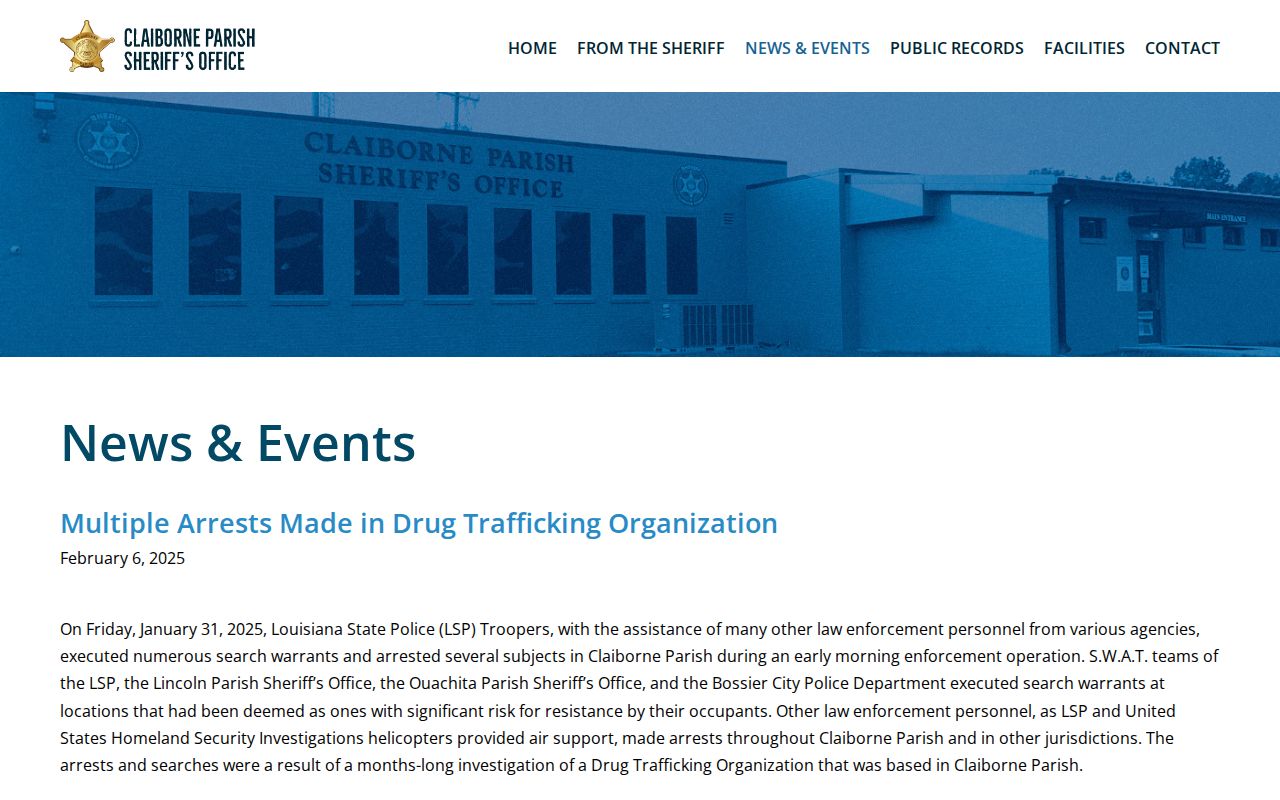
The article image can identify a news event. It cannot authenticate a later release or replace the maintained booking photograph.
Search by name and event date, then compare identifiers with the court and custody record. A news caption may use a shortened name or cover several people. Removal of an article also cannot prove that the underlying agency record was expunged or that custody changed.
Claiborne State Offender Photos
Louisiana DPS&C routes public offender searches through LAVNS/VINELink. The reviewed official instructions promise search by location, name, or ID or case number and include prison, probation, and parole information. They do not promise that a photograph will appear for every person who has been released or discharged.
Search the live record and compare the DPS&C number, name, date of birth or age, facility, reporting agency, and status. If an image appears, treat it as part of that state record. Do not assume it is the photograph from a separate Claiborne Parish booking. If the fully discharged person is no longer displayed, request the state record and identify the DPS&C number, former facility, and approximate dates.
State status and photo presence answer different questions. A community-supervision status can support that physical imprisonment ended in that case. A photo can help locate the associated record, but identifiers remain more reliable for distinguishing people with similar names.
Claiborne Mugshots and Expungement
Louisiana Code of Criminal Procedure article 972 defines expungement as removal from public access rather than destruction. Its scope expressly reaches arrest-event materials such as photographs, fingerprints, reports, and dispositions. Article 973 makes an expunged arrest or conviction record confidential, subject to specified access. A public photo can therefore become unavailable while a restricted agency record remains.
An absent image is not proof of expungement. Find the court order or obtain an authorized confirmation. Agencies and publishers may update at different times, and article 974 provides a notice process that can matter when a lawful expungement must be carried downstream. Expungement is not synonymous with acquittal, pardon, or factual innocence.
For a dispute with an official source, identify the exact record, booking number, image URL if one exists, and the order or other legal support. Ask for the agency's stated procedure and preserve its response. Do not use a paid removal intermediary to replace direct review of the statute and record.
Louisiana Mugshot Removal Rules
Code of Criminal Procedure article 234 regulates qualifying remove-for-pay publication. It requires removal and destruction within seven calendar days after a supported request when the charge ended in acquittal or non-prosecution, or was expunged, vacated, or pardoned. The publisher may not charge for that removal. The law is not a declaration that every government mugshot must be open to the public.
R.S. 14:133.7 separately addresses publication of expunged or nondisclosed criminal-history information, charges to remove or correct it, and knowing maintenance of incomplete or inaccurate information within its scope. It requires a dispute contact and provides a process that can include an agency check and written result. Statutory exceptions also apply.
Read the current codified text before acting because the facts and scope control. A qualifying request should go to the party that publishes the image and should include the evidence the statute calls for. An official records custodian may have separate duties and lawful access limits.
Keep correction and release confirmation as separate tasks. A publisher can remove or correct an image without changing the court record, and an agency can restrict public access after expungement while retaining a confidential record. Save the request, delivery proof, supporting order, and written response. If a publisher claims an exception, compare that claim with the live statute instead of assuming that payment is required.
R.S. 14:133.7 describes a dispute contact and, when applicable, an agency check within 30 business days without charge, followed by a written result within five business days. Those time frames apply within that statute's scope. They do not set CPSO production time or guarantee that an image must be removed for reasons outside the listed law.
A dated copy of the live page can document what was displayed when the dispute began. Pair it with the agency record and exact person identifiers.